This post may contain affiliate links. Please read our disclosure policy.
Every time we’re in Greece — most often Halkidiki — I find the nearest bakery and order bougatsa. Warm phyllo, creamy semolina custard, a snowfall of powdered sugar and cinnamon on top. It’s the one thing I never skip there, and since nobody sells it where I live, I learned to make it at home.
This bougatsa recipe is the closest I’ve gotten to the bakery version, and it’s much easier than those shattery golden layers suggest.
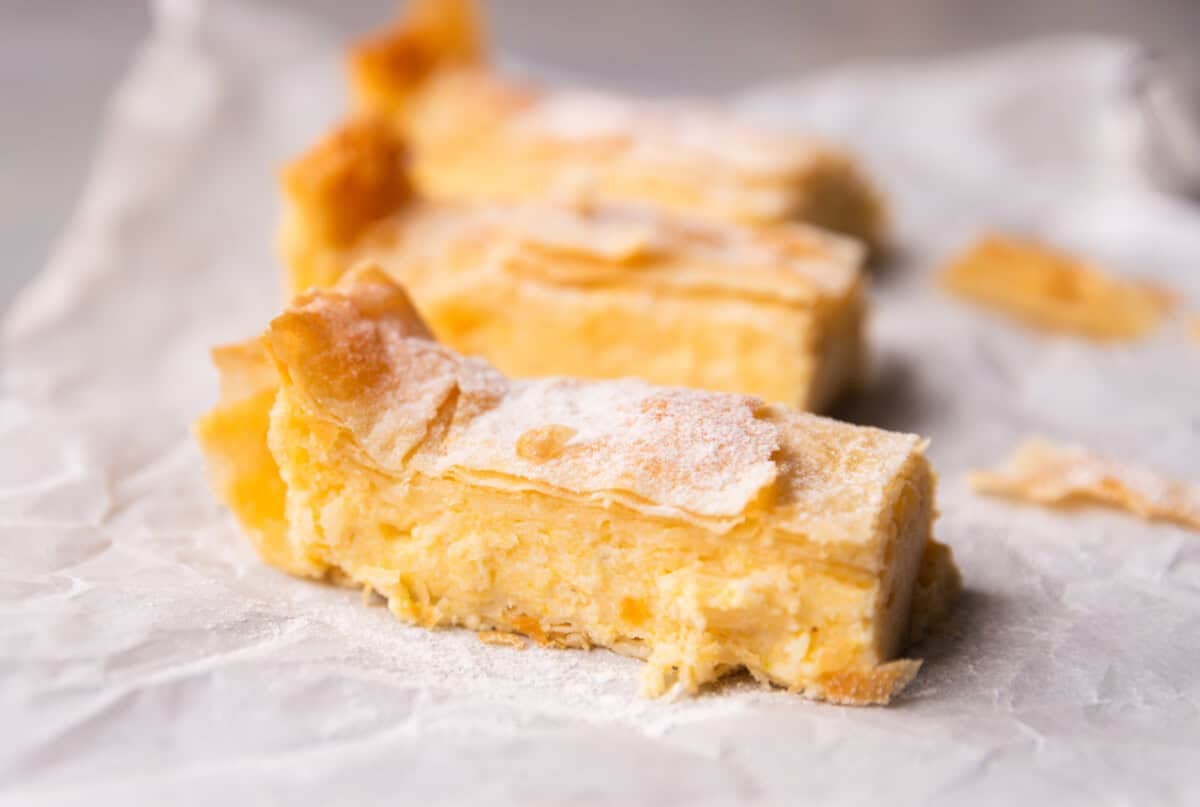
For me it tastes like a sweet banitsa — we grew up on phyllo in Bulgaria, but we don’t have anything quite like bougatsa.
I’ll be honest: I eat low carb desserts most of the year and rarely bake with sugar these days.
This is the exception. I stay active so I can enjoy a warm piece of bougatsa without a second thought — in Greece or in my own kitchen.
Why You’ll Love This Recipe
For something that looks like a bakery showpiece, the ingredient list is short — milk, semolina, sugar, butter, and a package of phyllo.
The custard comes together in one pot on the stove, the whole thing bakes in a 13×9 dish, and you get 12 generous pieces from one pan. I make it when I miss Greece.

How to Make Bougatsa
Two parts: cook the custard, then layer and bake. Neither is complicated.
- Heat the milk in a pot over medium heat until it just begins to simmer.
- Add the semolina and sugar, lower the heat to medium-low, and stir constantly for 7–8 minutes, until the custard thickens. Stir in the zest, if using.
- Strain the custard into a bowl — this catches any lumps, so the filling bakes silky.
- Stir in the butter and vanilla. Press plastic wrap directly onto the surface and let the custard cool while you set up the phyllo.
- Preheat the oven to 350°F (180°C) and butter a 13×9 inch baking dish.
- Unroll the phyllo and cover it with a damp towel — uncovered sheets dry out and crack within minutes.
- Lay 1 sheet in the dish and brush with melted butter. Repeat with half the sheets (6 total), buttering each one.
- Spread the custard over the phyllo in a smooth, even layer.
- Layer the remaining 6 sheets on top, brushing each with butter. Trim any phyllo hanging over the edges and butter the top.
- Score the top into squares or rectangles with a sharp knife.
- Bake for 30–40 minutes, until deep golden.
- Cool at room temperature until the custard sets, then slice along the scored lines and dust with powdered sugar and cinnamon.
Tips
Dust the sugar and cinnamon just before serving. On warm phyllo, powdered sugar melts into a glaze within minutes — add it early and you lose the classic snowy top.
Buy thin phyllo — #4 if it’s numbered. I use Bulgarian or Greek brands; thicker sheets bake up bready instead of crisp and flaky.
Don’t skip the scoring. Once the top bakes crisp, a knife pressed through it shatters the layers — the pre-cut lines are what give you clean bakery-style squares.

Serving Ideas
In Greece bougatsa is a breakfast, eaten standing up with a coffee, and that’s my favorite way to have it at home too — a slightly warm piece with a strong coffee mid-morning.
It also holds its own as an after-dinner dessert, chilled straight from the fridge, when the custard is at its firmest.
If Eastern European sweet breakfasts are your thing, my Syrniki are the pan-fried cheese version of this ritual. And for another custard-filled pastry — this one Bulgarian — try my Custard Filled Pastry Horns (Funiiki).
More Phyllo Recipes
A package of phyllo usually holds more than the 12 sheets this Greek custard pie needs, and the leftover sheets dry out fast in the fridge — so I plan a second bake from the same package.
On the savory side there’s classic Spanakopita (Spinach and Feta Pie) and Phyllo Swirls with Eggs and Feta, which are the closest thing to Bulgarian banitsa on my site.
For smaller bites, Egg, Leek and Feta Phyllo Cups and Mediterranean Phyllo Cups work for brunch or appetizer spreads.
And in the fall, Pumpkin Phyllo Triangles are the sweet ones my family asks for.

Bougatsa (Greek Custard Phyllo Pie)
Ingredients
For the pastry:
- 12 thin phyllo pastry sheets, #4
- 120 grams 4 oz butter, melted
For the custard:
- 4 cups milk, non-dairy works too
- 1 cup semolina
- 1 cup sugar
- 60 grams 2 oz butter
- 1 tsp vanilla extract
- 1 tsp lemon or orange zest, optional
For serving:
- Confectioners’ sugar
- Ground cinnamon, optional
Video
Instructions
- Heat the milk on the stovetop until it begins to simmer. Add the semolina and sugar, lower the heat to medium-low, and stir constantly for 7–8 minutes, until thickened. Add the zest, if using.
- Strain into a bowl. Stir in the butter and vanilla. Cover tightly with plastic wrap and let cool.
- Preheat oven to 350°F (180°C). Grease a 13×9 inch baking dish with butter.
- Unroll the phyllo and cover with a damp towel. Place 1 sheet in the dish and brush with butter. Repeat with half the sheets, buttering each.
- Spread the custard in a smooth layer. Top with the remaining sheets, buttering each. Trim overhanging phyllo and butter the top.
- Score into squares or rectangles with a sharp knife.
- Bake 30–40 minutes, until golden.
- Cool at room temperature, slice, and dust with powdered sugar and cinnamon.
Notes
- Thaw frozen phyllo in the fridge overnight before using.
- The custard is soft when hot — it needs the cooling time to set.
Nutrition
Nutrition information is automatically calculated, so should only be used as an approximation.
FAQ
What is the difference between bougatsa and galaktoboureko? Both are Greek phyllo-and-custard pies, but galaktoboureko is soaked in syrup after baking, so it’s much sweeter and wetter.
Bougatsa skips the syrup — the phyllo stays crisp and dry, and all the sweetness comes from the custard plus the powdered sugar on top.
If you’ve only tried galaktoboureko, bougatsa is the lighter, crispier cousin.
What kind of semolina should I use for the custard? There are different options, and they all work — fine semolina, coarse semolina, or grits, which is what I use.
Grits is the easiest to find in a US grocery store, and the custard cooks up creamy with just a hint of texture, the way I’ve had it in Greek bakeries.
Should bougatsa be served warm or cold? In Greek bakeries it’s served warm, and that contrast — crispy buttery phyllo against creamy custard — is the whole point.
At home, give it time to cool first: slice it slightly warm or chilled so the custard holds its shape, because cut too hot, it runs.
Between the two, I take slightly warm every time.
How do I store and reheat bougatsa? It keeps in an airtight container in the fridge for up to 3 days — the dairy custard means it must be refrigerated.
To bring back the crunch, reheat slices on a baking sheet at 350°F (175°C) for 8–10 minutes. Skip the microwave; it turns the phyllo soggy.