This post may contain affiliate links. Please read our disclosure policy.
Baklava is a regional dessert shared across the Balkans, Greece, Turkey, and the Eastern Mediterranean. What defines a good baklava recipe isn’t a single country or childhood story, but technique: ultra-thin filo, butter between layers, nuts, and syrup poured at the right moment.

I grew up in Bulgaria, surrounded by Greek and Turkish culinary influence, where filo pastries and nut-filled desserts were familiar, not exotic. Baklava was a celebration dessert, made with patience and intention. Every family had their own version, and details mattered.
This is a classic baklava recipe, written the way baklava is commonly made in Bulgaria today: practical, balanced, slow-baked, and focused on texture rather than excess sweetness.
Why You’ll Love This Baklava Recipe
- Works in a standard home oven
- Reliable method that prevents soggy or greasy layers
- Balanced sweetness that lets the nuts shine
- Slow-baked for crisp, flaky texture throughout
- Flexible with nuts, syrup style, and layering

What Makes This Baklava Recipe Work
- Cold syrup poured over hot baklava
- Extra-thin filo for delicate layers
- Clarified butter to prevent burning
- Mixed nuts for depth and balance
- Low, slow baking to dry the pastry evenly
Ingredients

For the baklava
- 400–480 g (14–16 oz) extra-thin filo pastry, thawed
- 280 g (10 oz) unsalted butter, melted (preferably clarified)
Nut filling
- 200 g (7 oz) pecans
- 200 g (7 oz) walnuts
- 50 g (1.7 oz) pistachios
- 2 tsp ground cinnamon
Syrup
- 1½ cups sugar
- 1½ cups water
- Peel of 1 lemon (no white pith)
- 1 small strip orange peel
- 1 cinnamon stick
- 1 tbsp lemon juice
- 1 tsp vanilla extract
Optional:
Replace part of the sugar with honey (1 cup sugar + ⅓ cup honey).

How to Make Baklava
Make the syrup (first)
- Combine sugar, water, lemon peel, orange peel, cinnamon stick, and lemon juice.
- Bring to a boil, then simmer for 10 minutes.
- Remove from heat, stir in vanilla, and let cool completely.
- Discard peels and cinnamon stick.


The syrup must be cold when poured over the baklava.
Prepare the nut filling
Pulse all nuts with cinnamon until finely chopped but not powdered. Set aside.

Assemble
- Preheat oven to 130°C / 265°F.
- Cut filo sheets in half to fit a 9×13-inch (23×33 cm) glass baking dish.
- Keep filo covered while working.
Layering method
- 10 filo sheets, brushing each lightly with butter
- Sprinkle ⅙ of the nut mixture
- 5 filo sheets, buttered
- Nut mixture


Repeat until nuts are used. Finish with 5 buttered filo sheets on top (or if you have more then 5 left, use them all).
Cut and bake
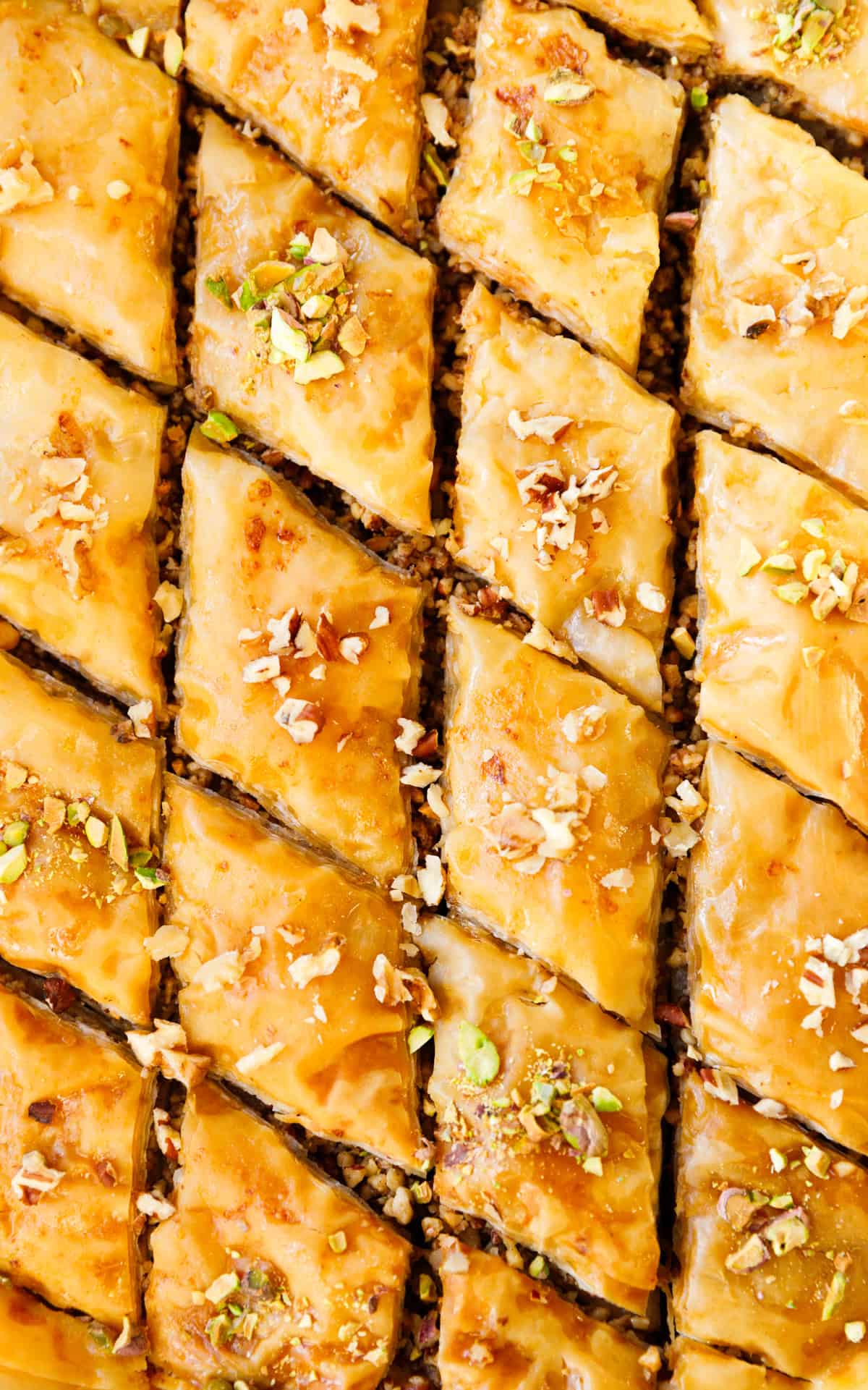
- Cut into diamond shapes with a sharp knife, all the way through.


- Bake 90–100 minutes, until deeply golden and crisp.
- Baking time may vary, the baklava has to become golden and crispy.

Add the syrup
Immediately pour cold syrup over hot baklava.
Cool uncovered for 4–6 hours, preferably overnight.


Thin vs Thick Syrup: How Syrup Affects Baklava Texture
Syrup consistency has a direct impact on texture. There is no single “correct” thickness.
Thin syrup
- Higher water ratio
- Absorbs quickly
- Creates softer baklava
- Lets nut flavor stand out
Common in many Balkan home-style versions.
Thick syrup
- Higher sugar concentration
- Absorbs more slowly
- Creates firmer or harder layers as it cools
- Can crystallize if overcooked
Often used when baklava needs to hold its shape longer.
What I prefer
A medium-light syrup: absorbed evenly, sweet but not heavy, crisp without drying out.

Variations
Nuts
- Walnut baklava (very traditional in the Balkans)
- Pistachio baklava (Turkish-style)
- Walnut + pistachio
- Walnut + pecan
Avoid nut flours or pre-ground nuts.
Layering
- Nuts throughout the layers (softer center)
- One thick nut layer in the middle (extra flaky top and bottom)
- Hybrid layering (balanced texture)
All are correct.
Syrup
- Sugar-only syrup (classic)
- Sugar + honey (very common)
- Honey-only syrup (stronger flavor)
- Citrus-forward syrup
- Light spices (cinnamon, cloves used sparingly)
Low-carb adaptation
Not traditional, but possible with alternative sweeteners. Expect different syrup texture and less shine.

Frequently Asked Questions
Yes. It follows classic technique with regional Bulgarian influence.
Walnuts are traditional in the Balkans. Pistachios are common in Turkish baklava. Mixed nuts are widely used in home kitchens.
Warm syrup, too much syrup, or baking at high heat.
Over baking or syrup that is too thick and crystallizes.
Yes. Baklava improves after resting overnight.
No. Refrigeration ruins the texture.
Yes, baked and cooled without syrup. Add syrup after thawing.
Similar Recipes
- Pumpkin Phyllo Triangles
- Egg, Leek and Feta Phyllo Cups
- Coconut Pecan Baklava
- Phyllo Swirls With Feta
- Baklava Bites
- Phyllo Baklava Bites

Baklava Recipe
Ingredients
Baklava
- 14 –16 oz, 400–480 g extra-thin filo pastry
- 10 oz 280 g unsalted butter, melted (clarified preferred)
Nut filling
- 7 oz 200 g pecans
- 7 oz 200 g walnuts
- 1.7 oz 50 g pistachios
- 2 tsp ground cinnamon
Syrup
- 1½ cups sugar
- 1½ cups water
- Lemon peel
- Orange peel
- 1 cinnamon stick
- 1 tbsp lemon juice
- 1 tsp vanilla extract
Instructions
- Make syrup. Simmer sugar, water, citrus peels, cinnamon, and lemon juice for 10 minutes. Cool completely. Stir in vanilla.
- Pulse nuts with cinnamon until finely chopped.
- Preheat oven to 265°F (130°C). Butter a 9×13-inch glass baking dish.
- Layer 10 buttered filo sheets.
- Add ⅙ of nut mixture.
- Layer 5 buttered filo sheets, then nuts. Repeat.
- Finish with 5, or as many as you have left buttered filo sheets.
- Cut into diamonds.
- Bake 90–100 minutes until golden.
- Pour cold syrup over hot baklava. Cool 4–6 hours.
Notes
Nutrition
Nutrition information is automatically calculated, so should only be used as an approximation.
Updated with notes on syrup thickness, slow baking, and regional variations.