This post may contain affiliate links. Please read our disclosure policy.
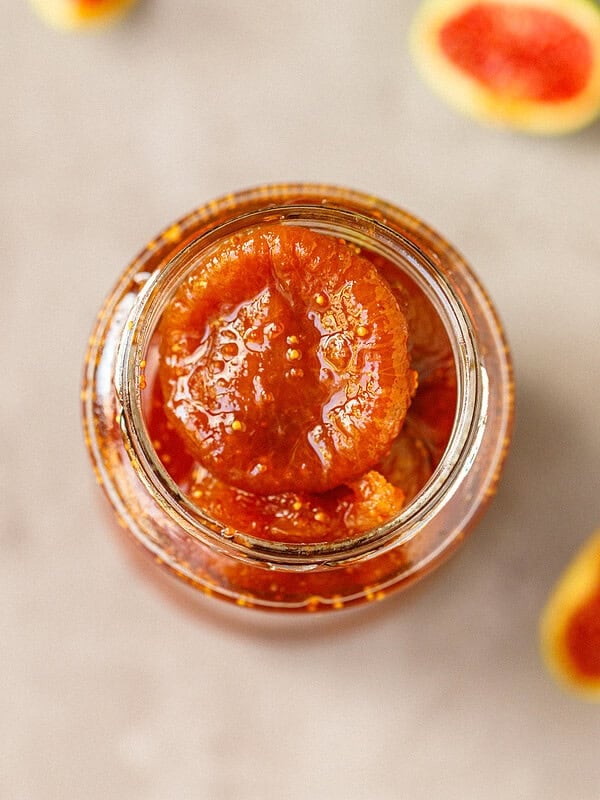
Easy homemade fig jam with fresh figs, sugar, lemon juice and water. No pectin, one pot, ready in 30 minutes, with fridge and canning options.

This fig jam started with more figs than my family could eat.
They came from a backyard tree that belongs to my boyfriend’s grandma’s uncle, and after a smoothie and a few days of snacking, the rest went into a pot.
Peeled figs, sugar, lemon juice and a splash of water simmer into a thick, glossy fig jam in about 30 minutes, with no pectin and no special equipment.
You end up with about 3 jars of golden-orange jam, packed with tiny seeds, for toast, yogurt and cheese boards.
The thing I learned: peel the figs if they’re ripe. Soft figs peel in seconds by hand, and without the skins the homemade fig jam cooks down silky and bright instead of dark and chewy.
The lemon juice matters more than you’d think, too.
Figs are naturally low in acid, so the lemon balances the sweetness, helps the jam set without pectin, and makes it safer to store.
Why You’ll Love This Recipe
Fresh fig jam is one of the easiest jams to make: four ingredients, one pot, and no pectin because figs thicken on their own.
It tastes like honey and caramel with a little tang, nothing like the dark, overly sweet store-bought kind. Just know it’s still jam.
One tablespoon has about 40 calories and 9 grams of sugar, so I use it by the spoonful on Greek yogurt or cottage cheese, not by the jar.

How to Make Fig Jam
Peel and mash, simmer until thick, jar it.
- Trim the stems, peel the figs by pulling the skin back with your fingers, and mash them in a bowl with a potato masher or fork. Leave some small chunks for texture.
- Add the figs, sugar, lemon juice and water to a heavy-bottomed saucepan and stir.
- Bring to a boil over medium-high heat, stirring until the sugar dissolves, about 3–4 minutes.
- Lower the heat to medium and simmer, stirring every few minutes, for 25–30 minutes, until the fig jam is thick and glossy and the fruit has broken down completely.
- Check that it’s done: drop a spoonful onto a cold plate from the freezer, wait 1 minute and push it with your finger. If it wrinkles, it’s ready. If it runs, simmer 3–5 minutes more and test again.
- Ladle the hot jam into clean, hot jars, leaving ¼ inch of space at the top, and close the lids.

How to Store Fig Jam
For the fridge, let the jars cool on the counter, then refrigerate for up to 3 weeks.
For the pantry, use bottled lemon juice instead of fresh (its acidity is consistent), process the filled jars in a boiling water bath for 10 minutes (add time if you live at high altitude), let them cool undisturbed for 24 hours, and check that the lids have sealed. Sealed jars keep in a cool, dark cupboard for up to a year.

Tips
- Peel ripe figs, skip peeling unripe ones. Ripe figs peel by hand in seconds with no blanching. Firmer figs are hard to peel, so just mash them with the skin on; the jam will be darker and a little chunkier.
- Don’t cut the lemon juice. It’s what makes the fig jam set without pectin and gives it the acidity it needs for safe canning.
- Use a wide, heavy pot. Jam thickens faster and is less likely to scorch on a wide surface. Stir more often in the last 10 minutes, when it starts to stick.
- Trust the cold plate, not the clock. Fig jam thickens a lot as it cools. If it looks thick in the pot, it’s probably overcooked.
- Green or purple figs both work. Green figs make a golden-orange jam like mine; purple figs make it deeper red.
- Want less sugar? You can cut it to 1 cup, but the jam will be looser and should stay in the fridge instead of the pantry.
Serving Ideas + More Recipes
My favorite way to eat fig jam is a spoonful swirled into plain Greek yogurt or cottage cheese for a high-protein snack that tastes like dessert. It’s also a classic on a cheese board next to aged cheddar, brie or salty feta, and it’s great on warm scones.
Bake a batch of my Cottage Cheese Scones and serve the fig jam on the side.
For a quick lunch, spread a thin layer under the burrata on my Fig Toast with Burrata and Arugula in place of the balsamic drizzle.
And if you still have fresh figs left, blend a Fig Smoothie for breakfast, or leave them whole for my Whole Fig Preserves in Syrup (Bulgarian Sladko), the Bulgarian spoon-sweet version.
Homemade Fig Jam
Ingredients
- 2 pounds 900 g fresh green or purple figs, stemmed, peeled and mashed
- 1½ cups 300 g granulated sugar
- ¼ cup plus 2 tablespoons fresh lemon juice
- ½ cup water
Instructions
- Add the mashed figs, sugar, lemon juice and water to a heavy-bottomed saucepan.
- Bring to a boil over medium-high heat, stirring until the sugar dissolves.
- Reduce to medium and simmer 25–30 minutes, stirring often, until thick and glossy.
- Test a spoonful on a cold plate; it should wrinkle when pushed. Cook a few minutes more if needed.
- Ladle into clean, hot jars, leaving ¼ inch headspace, and seal.
- Refrigerate up to 3 weeks, or process in a boiling water bath for 10 minutes for pantry storage.
Notes
- No need to peel firm figs; mash them with the skin on.
- Less sugar: use 1 cup, and store the jam in the fridge only.
- Canning for the pantry: use bottled lemon juice.
- About 9 g sugar per tablespoon.
- Nutrition information per cup.
Nutrition
Nutrition information is automatically calculated, so should only be used as an approximation.
FAQ
Do you need pectin to make fig jam? No. Figs are naturally thick and the lemon juice helps the jam set, so all you need is time on the stove. The cold plate test tells you when it’s done. If it wrinkles after a minute in the freezer, it will set up in the jar.
Should you peel figs for jam? Only if they’re ripe and soft. Peeled figs make a smoother, brighter fig jam, and ripe ones peel by hand with no blanching. Firm figs don’t peel easily, so leave the skin on and mash them anyway; the jam will just be darker and chunkier.
How do I fix fig jam that’s too runny or too thick? If it’s runny after cooling, pour it back into the pot and simmer 5 more minutes, then do the cold plate test again. If it’s too thick, stir in 1–2 tablespoons of hot water while it’s warm. Most people overcook fig jam, because it looks thin in the pot and thickens a lot as it cools.
Is fig jam healthy? It’s a treat, not a health food. One tablespoon has about 40 calories and 9 grams of sugar, most of it from the added sugar. I keep it to a spoonful on protein-rich foods like Greek yogurt, cottage cheese or cheese, where a little goes a long way.